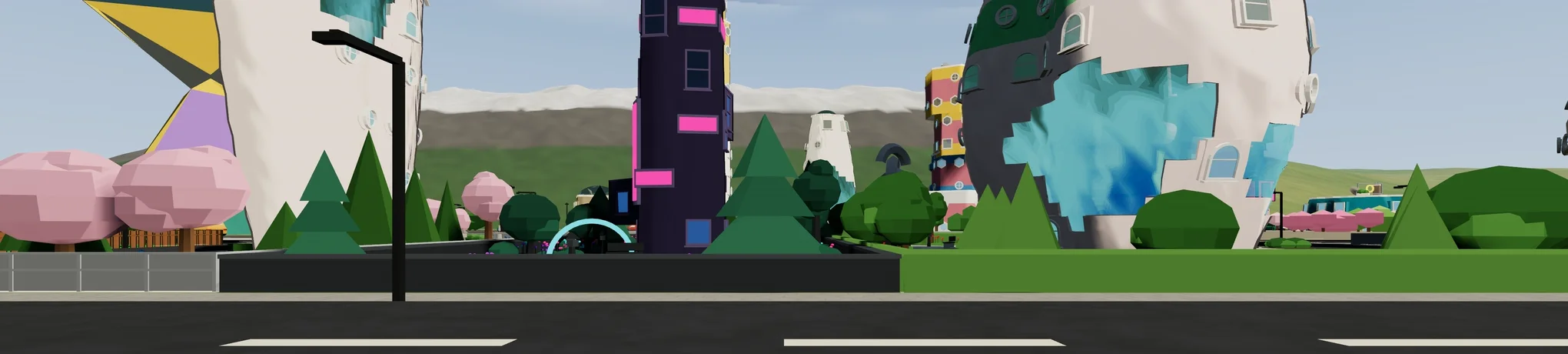
Development story · September 2026
From map experiment to living city
Trip City began with a simple question: what would it take to make a generated city feel alive? The answer grew from a 3D map experiment into a place where roads connect, buses run, people have somewhere to go and every building can tell a slightly different story.
The road to release
-
A city on a real map
The first version was a different kind of experiment. Built for TripGeo Labs, it used MapLibre to visualise real-world places in 3D, with animated vehicles and pedestrians bringing movement to familiar streets. It established the central idea—cities are more interesting when they behave—but it was still a viewer of places that already existed.
-
Trip City becomes its own place
The current project began as a side project from Tanklands. Tanklands already generated city areas with roads and voxel buildings, and that small piece of a larger game felt worth exploring on its own. The first Trip City prototype was deliberately modest: a static voxel city generated in the browser, viewed from above.
-
The first release
Two months of rapid experiments turned the static model into a sandbox. Roads, traffic and pedestrians arrived; buildings and gardens were rebuilt; buses, missions and portals gave the city things to do. The initial release is a milestone rather than a finish line: the city is playable, but it is still growing.
First, make it move
A skyline can look convincing in a still image and still feel empty the moment you explore it. Roads were the first important addition because they gave the generated blocks a structure and suggested journeys through the city. Cars followed, then pedestrians, each turning the road network from scenery into a system.
That progression changed the aim of the project. Trip City was no longer only about generating an attractive arrangement of voxels. It became a simulation where the different parts had to agree: vehicles need usable lanes, pedestrians need safe routes, and both need believable destinations.
Buildings with a family resemblance
The original voxel buildings did their job, but they did not have enough character. A city made from the same small set of forms quickly reveals the repetition behind it, however colourful those forms are.
After a series of experiments, the voxel buildings were replaced with a procedural building system. Each building starts with an architectural template, then varies its proportions, materials and details to suit its plot. The result is a useful balance: neighbouring buildings can look as though they belong to the same city without becoming copies of one another.
Turning space into places
Gardens & land
Beyond the front door
The same procedural approach expanded into gardens, giving homes boundaries, planting and small details that make a plot feel occupied. Parks and farms broadened that idea from private land to shared and working landscapes, so open space became part of the city rather than a gap between buildings.
Shops
Interiors worth visiting
Shops made buildings more than façades. Being able to walk inside changes the scale of the whole experience: the city is not just something to survey from above, but somewhere to cross on foot, enter and explore at street level.
More reasons to stay awhile
Quests & missions
Small stories in the sandbox
Missions are optional modes layered onto the city. They are intentionally simple at the moment: deliver pizzas, sell ice creams, or join a dance party in the park. Each one tests how a generated city can become a setting for play without losing its open-ended character.
Portals
A doorway to other games
Portals provide a way to place mini-games inside the wider world. Some wait beyond the city limits and others can appear in parks; walking through an arch takes you into a separate experience, then returns you to the city when you are done.
Buses
See the city from a different seat
Buses tie many of the systems together. You can ride as a passenger, follow a bus through the streets, inspect its route and even create routes of your own. It is both transport and a quiet way to watch the simulation unfold.